Montage, montage, монтаж: the career of a word
Film scholar Ivan Cerecina traces the history of the word "montage" in its movement between French, English, and Russian contexts, and considers its enduring legacy as a key method of modernity.
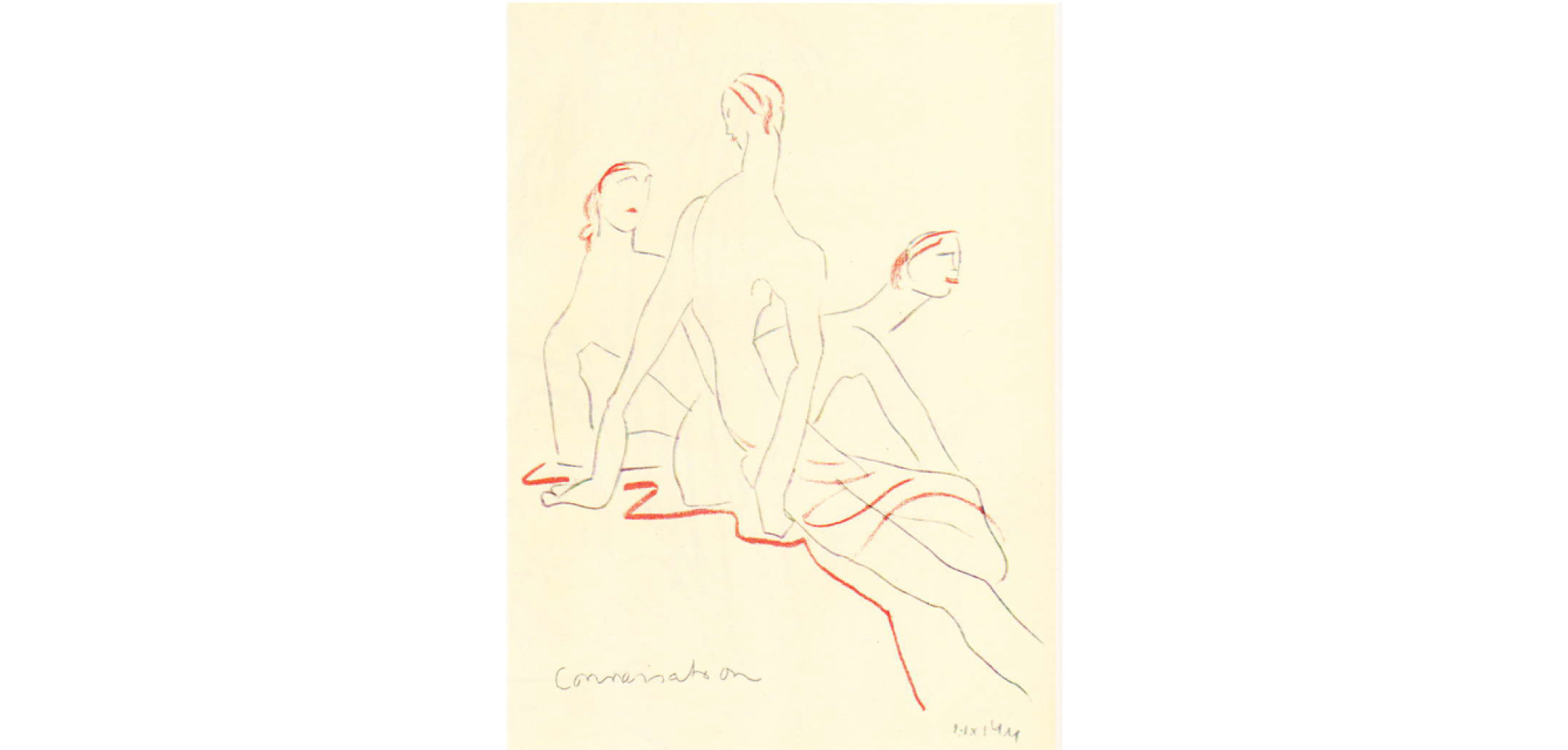
Sergei Eisenstein, Беседа [Conversation] (1944). Black graphite, coloured pencil on paper.
In his 1945 essay “How I Became a Film Director,” Sergei Eisenstein recalls the apparition of a word, “borrowed from industry,” that had entered both the Russian language and his own artistic conscience during the creative efflorescence of the 1920s. The French “montage” – from “monter”, to assemble, erect, or mount – had once denoted the fitting together of industrial parts: machinery, vehicles, piping. The Russian loanword,montazh, came to designate the editing together of strips of film, at a moment when the rhythms of the factory floor and the principles of mechanical assembly became models for thinking about cinematic construction, social organisation, and perception itself.
This paper traces the etymology, migration, and legacy of montage across French, English, and Russian, showing how the term has continually mediated between the technical and the conceptual, the manual and the intellectual. It explores how, after its theorisation in the Soviet 1920s, and its adoption in Hollywood in the late silent era, montage was reclaimed in postwar France—by filmmakers such as Vedrès, Resnais, and Marker—as a means of reassembling fragments of the past and negotiating the temporal and historical ruptures of modernity. In this renewed encounter, montage returns to its original language but carries with it the sedimented meanings of its international career. The paper concludes by tracing the continuing life of the word as a method of modernity: an enduring principle of composition that links the assembly line, the film reel, and the digital timeline.
Part of the Art History Seminar Series, convened by Mary Roberts and Nick Croggon, and presented by the Power Institute and the discipline of art history at the University of Sydney.
Join via Zoom
People
Ivan Cerecina
Ivan Cerecina teaches film studies at The University of Sydney. His work has been published in Screen, Camera Obscura, and Framework. His first monograph, Assembly Lines: Montage in Postwar French Film, is forthcoming with University of Minnesota Press.
Related
Thu, 14 May 2026
3:00PM
Grassroots Archivists: Photo Albums from the Queer Archives
Aiden Magro