Material marketing: How Canton manufacturers sold embroidered silk shawls, 1800-1930
A presentation on the significance of pattern books in late imperial Guangzhou textile circulation, trade and develoment.
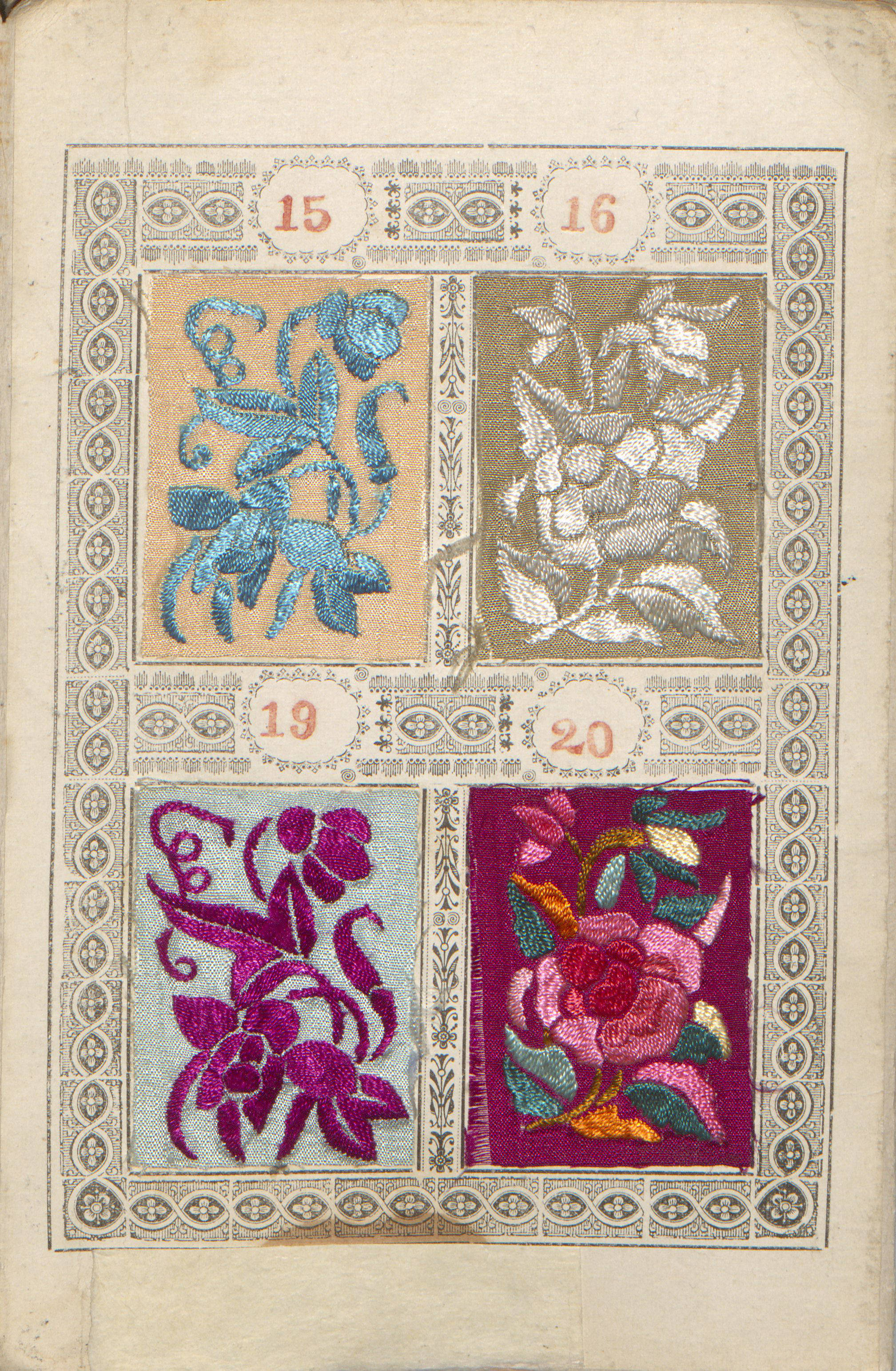
Chinese silk embroidery sample book, 19th–early 20th century. Accordion-folded album with floral motifs in multiple colorways. The Metropolitan Museum of Art, Irene Lewisohn Costume Reference Library, gift of William M. Lipton.
In late imperial Guangzhou, pattern books containing samples – small pieces of cloth which revealed the quality and novelty in material, structures, and pattern of a textile – were key tools for manufacturers of embroidered silk shawls. The textile trade relied on the use of such books, helping foreign customers make informed choices about embroidery techniques, pattern, colour, and drape; physical and aesthetic qualities which were difficult to represent satisfactorily in either words or images. Taking as its point of departure, three such books in collections across Australia (University of Sydney), North America (The Metropolitan Museum of Art), and the United Kingdom (Jardine Matheson Archive), this paper examines the decision-making processes, quality standards, and market adaptations that shaped the transcultural trade.
How did the often serialised combination of colours, repeat patterns, and motifs allow manufacturers to accommodate changes in fashion for new designs into ready-made decorative schemes? This paper treats the pattern book as a source for understanding: a) the methods by which these textiles were marketed and the nature of commercial correspondence between merchants and international markets, and b) the importance of merchants who possessed skills in innovation and knowledge of overseas fashions, enabling them to shape and predict global tastes.
Part of the Art History Seminar Series, convened by Mary Roberts and Nick Croggon, and presented by the Power Institute and the discipline of art history at the University of Sydney.
Join via Zoom
People

Maria Karageorge
Maria Karageorge is a PhD candidate at the University of Sydney, researching the history of the mantón de Manila, an internationally popular dress accessory exported from China in the nineteenth century. She received her Bachelor of Advanced Studies (First Class Honours) in 2021 and was awarded the Francis Stuart Prize for her thesis on pictorial modernisms in Canton-made glass paintings. Her current research interests include trade art, women’s fashion, and the contributions of local artisans across Asia to global histories of dress. Recently (October 2026), she presented her PhD research at the International Symposium on “Chinese Export Art”: Trade in Asian Waters, hosted by the Hong Kong Maritime Museum.
Related
Thu, 13 August 2026
3:00PM
Making the modern Middle East: The new artist-illustrators, 1842-1890
Mary Roberts, Ekaterina Heath, and Lucy Pittman
Thu, 10 September 2026
3:00PM
The forgotten Donald Brook: Sculptor of post-war humanism
Roger Benjamin