
The Uncertain Image
A day-long symposium on the expanded and uncertain field of photography.
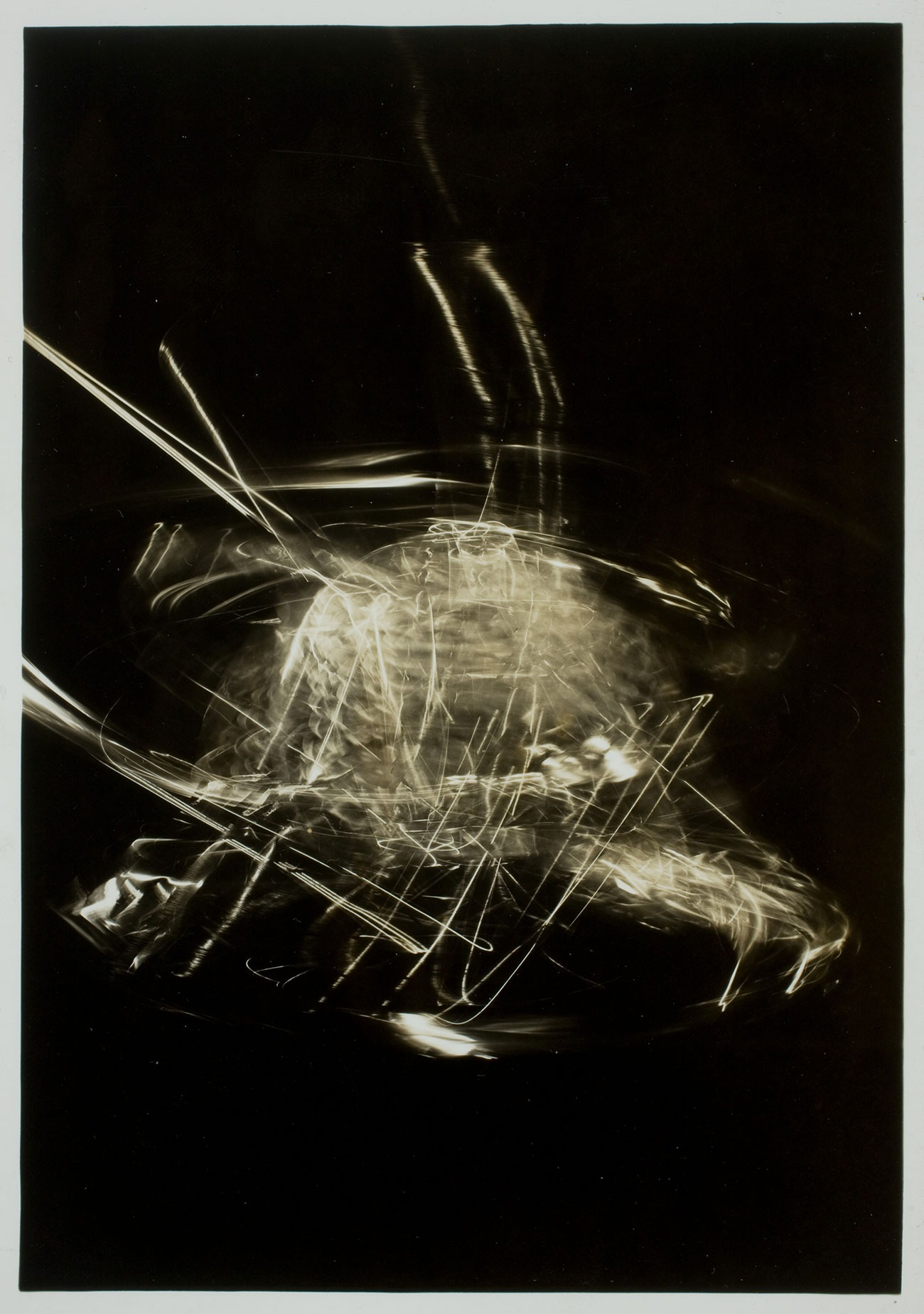
László Moholy-Nagy, Plexiglas-mobile in motion (1943), gelatin silver print.
Bringing together scholars, artists, HDR candidates, and early-career researchers, this symposium will explore the photographic in its most expanded sense. The event will consider how uncertainty operates within photographic images, practices, histories, theories, and systems of circulation.
From its earliest experiments, photography has raised questions about evidence, visibility, memory, representation and the instability of images. From synthetic and degraded images to archival loss and extractive practices, and from restorative justice and media manipulation to memory and decolonial fugitivity, the photographic image remains entangled in uncertainty. These questions have gained new urgency as photography expands across computational systems, generative technologies, the moving image, installation, archives, performance, and other material and networked forms.
As a cross-disciplinary forum for research on the photographic image across the School, and in dialogue with scholars from the field of photography, the day will support research development through shared discussion, mentoring, networking, and exchange across disciplines and career stages.
The symposium will include a lecture by Elisa deCourcy, and panel presentations by Rebecca Beardmore, Edwina Biggs, Danica Chappell, Harley Ives, Aiden Magro, Isobel Markus-Dunworth, Remi Siciliano, India Urwin and Tamara Voninski.
Convened by Donna West Brett and Yvette Hamilton, and presented by Photographic Cultures, The Power Institute, Art History, the Sydney College of the Arts, and the Chau Chak Wing Museum, as part of the SACE Research Event series.
Morning Session
9:15 – 9:30am Welcome
Donna West Brett and Yvette Hamilton
9:30 – 10:30am Keynote lecture
Elisa DeCourcy
10:30 – 11:00am Morning tea
11:00 – 12:00pm Panel 1
Rebecca Beardmore, Harley Ives, Edwina Biggs
Chair: Julie Rrap
12:00 – 1:30pm Panel 2
Aiden Magro, Danica Chappell, India Urwin
Chair: Elisa deCourcy
Afternoon Session
2:00 – 2:30pm Exhibition Tour: Tracey Moffatt Sorted
Lead by exhibition curator Katrina Liberiou
3:00 – 4:00pm Panel 3
Tamara Voninski, Remi Siciliano, Isobel Markus-Dunworth
Chair: Talia Smith
4:00 – 4:15pm Closing remarks
Donna West Brett and Yvette Hamilton
Keynote Lecture
Elisa deCourcy
Conjuring Theresa Walker's photographs of Litarimirina seaweeds: Art History at the crossroads of absence and abundance
During the first half of the 1850s, professional colonial sculptor and natural history colourist, Theresa Walker (née Chauncy) was making salted paper cameraless photographs of seaweeds where kanamaluka/the Tamar River meets the Bass Strait in northern lutruwita/Tasmania. None survive today. The record of Walker's photographic activity comes to us through itinerant Irish phycologist (algae specialist) William Henry Harvey who visited Walker in January 1855. In a letter penned to his sister, now held with his papers at the Grey Herbarium Harvard University, Harvey recalls meeting Walker and outlines the quantity and merit of her photographic seaweeds. This is the earliest recorded instance of a woman working with a photographic process in the Australian colonies.
Harvey is significant figure in nineteenth-century phycology and early histories of photography. His 1841 publication, A Manual of British Algae translated his academic work on seaweeds into a citizen science guide for collection and arrangement. It is Harvey and his work who is cited in the frontispiece of Anna Aitkins three-volume project, Photographs of British Algae (1843-53), completed entirely in cyanotype format (a similar, but not the same, cameraless photographic format to that used by Walker). Harvey is also the author of the five-volume encyclopedia, Phycologia Australica, the culmination of extensive network of correspondence and collection stretching the continent. My paper considers the global and local conversations on photography and maritime ecology to which Walker’s salted paper prints belong. Seaweed’s slippery mid-nineteenth-century imagery as both decorative and scientific; wild and collectable, gestures to the commencement of a broader set of colonial behaviours which worked to displace Litarimirina and Palawa custodianship of Sea Country, at a significant Cultural and ecological cost.
People

Elisa deCourcy
Dr Elisa deCourcy is a writer, academic and curator living and working on Ngunnawal and Ngambri Country. Elisa works in the field of critical colonial studies, frequently in collaboration and conversation with First Nations knowledge holders and artists. Between 2020-2023, she held an Australian Research Council DECRA fellowship at the Centre for Art History and Art Theory at the Australian National University. A major outcome of this project was her monograph, Early Photography in Colonial Australia published by Miegunyah/Melbourne University Press in November 2025. Elisa has been the recipient of fellowships from, and has given invited lectures at, the Harry Ransom Center at the University of Texas, Austin (2018); the Australian Academy of the Humanities (2018); the Bibliotheca Hertziana – Max Planck Institute of Art History, Rome (2023) and the University of Oxford (2023). She has written about photography and colonial art for the National Portrait Gallery, London, the Musée du Quai Branly, Paris, the National Gallery of Victoria, Naarm/Melbourne as well as a range of national and international scholarly journals. She is currently working special edition of Oxford Art Journal, co-edited with Emily Eastgate Brink, on new approaches to colonial Australian and Aotearoa/New Zealand art history.
Photo: Evan Jewell