
A Blade Across Empires: Prince Bambar’s Ceremonial Sabre
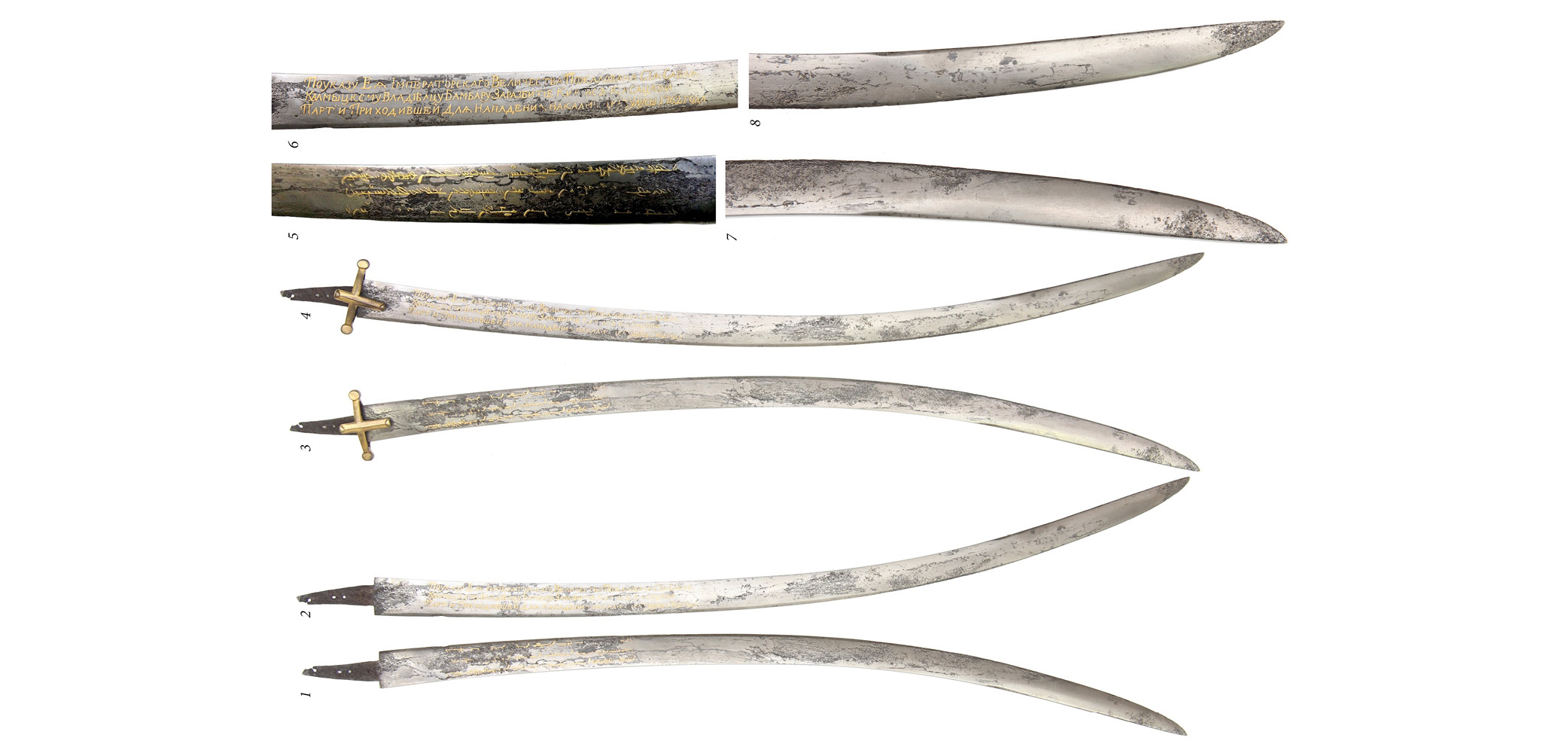
Art historian Ekaterina Heath traces the history of an 18th century sabre, examining its movement across Russian, steppe, and Qing imperial contexts, as part of a broader history of Kalmyk visual culture.
Noyon Bambar’s sabre, eighteenth century, The State Artillery Museum, St Petersburg.
Often dismissed as a peripheral artefact of diplomacy, a presentation sabre can function as a powerful political medium, carrying authority across languages, regimes, and imperial systems. Awarded by Catherine II to the Kalmyk leader Bambar in 1762, this gold-inscribed blade travelled from the Russian court across the steppe to Qing China during the Torghut migration of 1771, before reappearing as a Boxer-era war trophy and, later, a stripped-down museum object in St Petersburg. Tracing the sabre’s shifting meanings, from imperial reward to steppe diplomatic resource, Qing emblem of submission, and modern museum specimen, this paper argues that sovereignty in eighteenth-century Eurasia was not fixed or imposed, but materially staged, negotiated, and repurposed through objects that circulated far beyond their point of origin.
Part of the Art History Seminar Series, convened by Mary Roberts and Nick Croggon, and presented by the Power Institute and the discipline of art history at the University of Sydney.
Join via Zoom
People

Ekaterina Heath
Ekaterina Heath is an art historian working on the movement of images and objects across empires in the eighteenth and nineteenth centuries. Her research spans Russian imperial visual and material culture, Inner Asian and Kalmyk history, and the transnational circulation of prints and propaganda. Her book, Women, Gardens, and Agency in Imperial Russia: Empress Maria Feodorovna's Pavlovsk Park, was recently published by Bloomsbury Academic.