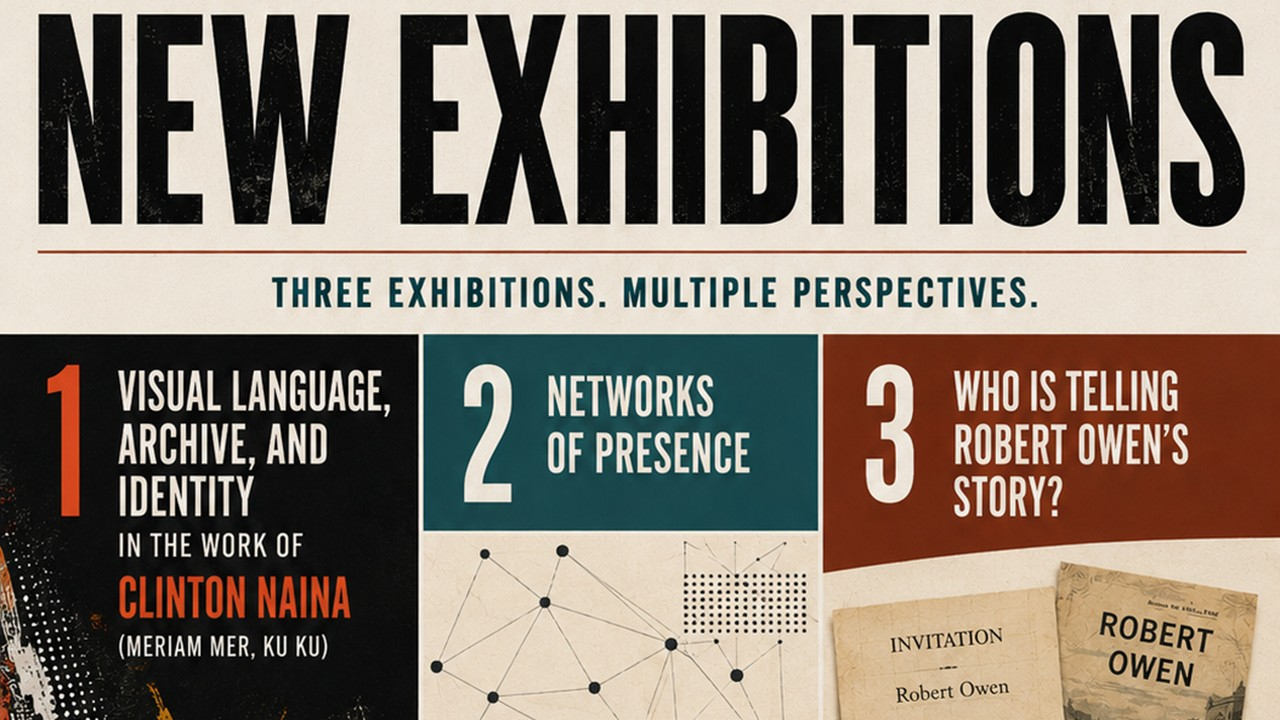
Three exhibitions drawing on the Schaeffer Fine Arts Library's archival materials, curated by the Library's 2026 interns.
In 2026, the Schaeffer Library has offered an exciting internship opportunity for students interested in the intersection of museum studies, art history and library science. This internship focused on capturing metadata for early works of artists, including books, diaries, notes, sketches, and other ephemera from our extensive archival collection.
The interns were each invited to present an exhibition at the Library, featuring some of their key findings. Learn more about each of these exhibitions below!
Visual Language, Archive, and Identity in the work of Clinton Naina
Isabel Wadeson-Lee
This exhibition positions Clinton Naina’s (Meriam Mer, Ku Ku) practice as counter-archival, examining how his visual language challenges colonial systems of knowledge while re-centering Indigenous epistemologies.
As art historian Ian McLean observes, urban Indigenous artists “used the archive as a repository through which to regain a lost identity that the archive had supposedly preserved.” Following this archival turn, Naina interrogates the colonial inheritances embedded within contemporary Australia, countering these narratives through the inclusion of oral histories and intergenerational knowledge.
This approach is expressed through Naina’s use of material, motif, and language. The exhibition is framed by his assertion: “As an artist, my language is the visual…I speak back and speak ‘Blak’ – and find the symbols and syllables of a new personal language.”
The political concerns explored within Naina’s practice carry both complexity and weight. Through his distinct voice as a gay Indigenous artist, Naina conveys frustration, passion, humour, and at times a wry eroticism. Positionality is central to his practice, inviting viewers to reflect on their own identities, perspectives, and frames of reference.
Ultimately, this exhibition considers how meaning is shaped not only through archives, but also through their absences. It foregrounds the ways memory is enacted, and knowledge is preserved through both institutional and counter-archival practices.
Who is Telling Robert Owen’s Story? Voices, Documents, and the Construction of an Artist Narrative
Yingduo Wang
This exhibition explores how an artist’s identity and legacy are shaped through archives, documents, and the institutions that preserve and interpret them. Focusing on materials related to Australian artist Robert Owen, the exhibition examines how invitations, exhibition catalogues, brochures, academic writing, media reports, and administrative records contribute to the construction of an artist’s public narrative.
Rather than simply recording an artist’s career, archival materials actively shape how artists are understood. Through language, interpretation, and institutional frameworks, these documents influence the ways audiences encounter and engage with artistic practice.
Bringing together a range of archival materials, the exhibition presents four perspectives that contribute to Robert Owen’s artistic identity: the institutional voice of the gallery, the interpretive voice of critics, the scholarly voice of researchers, and the administrative voice of the archive.
By revealing the relationships between artworks, documents, and narratives, the exhibition invites visitors to reflect on how artists are remembered and how meaning is created through the ongoing dialogue between archives, institutions, and audiences.
Networks of Presence: Hilarie Mais Artist Collection
Shiqiao Zhang
This exhibition explores the idea of “network” through the work, career, and archival traces of Australian artist Hilarie Mais. Drawing on selected materials from the Hilarie Mais collection donated by Sherman Galleries, the exhibition examines the connections between artistic practice, institutional networks, and collective memory.
The concept of “network” is explored through three perspectives: the visual networks of grids and lines within Mais’ artworks; the networks formed between artists, galleries, critics, audiences, and institutions; and the archival networks through which memories and histories are preserved.
Through original documents and archival materials, the exhibition reveals how art extends beyond individual works to create connections between people, places, institutions, and histories. It invites visitors to consider how archives preserve the relationships and movements that shape an artist’s practice and legacy.